


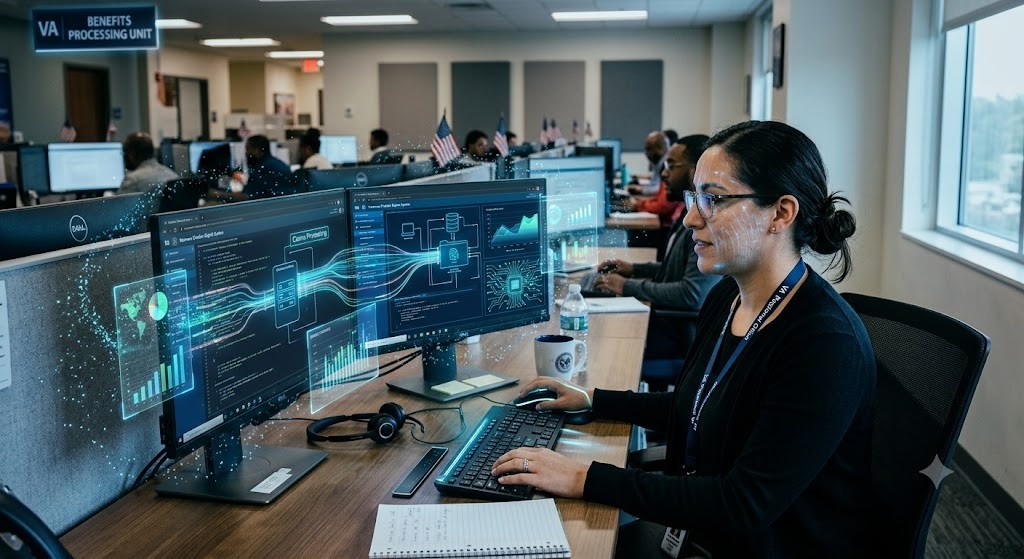
Veterans seeking disability compensation often face a process that involves extensive documentation, medical evidence, and multiple review stages. As the number of claims continues to grow, the U.S. Department of Veterans Affairs has increasingly adopted modern technology to improve how claims are received, reviewed, and processed. VA claims processing technology combines automation, digital records, artificial intelligence, and workflow management tools to help staff handle claims more efficiently while maintaining compliance with federal regulations.
Rather than replacing human judgment, these technologies are designed to reduce repetitive administrative work, organize information more effectively, and allow claims processors to focus on evaluating evidence. Understanding how these systems work provides valuable insight into the modernization of veterans’ services and the future of benefits administration.
The Shift from Paper-Based Claims to Digital Workflows
For many years, veterans’ claims relied heavily on paper files that moved between regional offices. This approach often resulted in slower processing times, misplaced documents, and limited visibility into a claim’s status.
Modern claims processing technology has transformed this workflow through digitization. Electronic claim files allow authorized personnel to access documents securely from multiple locations while maintaining a complete history of every action taken during the review process.
Digital workflows also make it easier to:
- Upload supporting evidence electronically
- Track pending tasks
- Route claims to appropriate specialists
- Reduce duplicate documentation
- Maintain detailed audit trails
This transition has laid the foundation for more efficient claims management across the entire VA system.
Core Technologies Supporting Modern Claims Processing
Several technologies work together throughout the claims lifecycle rather than relying on a single software platform.
Electronic Claims Management Systems
Electronic claims management platforms organize medical records, service history, correspondence, and supporting evidence into a centralized digital case file. This reduces manual handling while allowing reviewers to locate information quickly.
Optical Character Recognition (OCR)
Many veterans still submit scanned forms or paper documents. OCR technology converts printed text into searchable digital information, allowing claims processors to find relevant records without manually reviewing every page.
Although human verification remains important, OCR significantly reduces document handling time.
Workflow Automation
Routine administrative tasks can be automated, including:
- File routing
- Document classification
- Status updates
- Notification generation
- Evidence tracking
Automation helps eliminate repetitive work while ensuring required processing steps are completed consistently.
Artificial Intelligence as a Decision Support Tool
Artificial intelligence has become one component of VA claims processing technology, primarily serving as a support system rather than an automated decision-maker.
AI tools may assist by:
- Identifying missing documentation
- Highlighting relevant medical evidence
- Prioritizing incoming claims
- Detecting inconsistencies in submitted records
- Organizing complex case files
Importantly, disability determinations continue to require human review. Claims processors evaluate applicable laws, medical evidence, military service records, and eligibility requirements before decisions are finalized.
This human oversight helps maintain fairness while benefiting from technological efficiencies.
Digital Evidence Integration
Modern claims frequently involve information from multiple sources, including:
- Military service records
- VA medical centers
- Private healthcare providers
- Compensation and pension examinations
- Supporting statements
- Historical claim files
Technology allows these records to be integrated into a unified electronic case file, making it easier for reviewers to analyze evidence in context.
Instead of waiting for physical files to arrive, authorized personnel can often access available digital records much more quickly, reducing administrative delays.
Improving Accuracy Through Standardized Processing
Consistency is essential when processing disability claims. Technology supports standardized procedures by guiding reviewers through required steps and ensuring necessary documentation is considered before decisions are completed.
Examples include:
- Required evidence checklists
- Automated validation rules
- Case progress monitoring
- Regulatory reference tools
- Quality assurance checkpoints
Standardization helps reduce avoidable processing errors while promoting more uniform application of established policies.
Security and Privacy Considerations
Veterans’ claims contain highly sensitive personal and medical information. As a result, claims processing technology incorporates multiple security measures designed to protect confidential data.
Common safeguards include:
- Multi-factor authentication
- Role-based access controls
- Data encryption
- Continuous activity monitoring
- Audit logging
- Secure federal cloud environments
Federal cybersecurity requirements also require ongoing monitoring, vulnerability assessments, and regular system updates to protect information from unauthorized access.
Technology’s Role in Managing Large Claim Volumes
The VA processes hundreds of thousands of disability claims each year. Technology helps manage this workload by improving how cases are distributed among claims processors.
Modern workload management systems can:
- Balance assignments across regional offices
- Identify priority claims
- Monitor processing timelines
- Track performance metrics
- Reduce administrative bottlenecks
These capabilities improve operational efficiency without changing the legal standards used to evaluate claims.
Challenges That Technology Cannot Solve Alone
While digital tools have improved many aspects of claims processing, technology cannot eliminate every challenge.
Several factors still require careful human evaluation, including:
Complex Medical Evidence
Some disabilities involve multiple diagnoses, evolving medical conditions, or conflicting expert opinions. These situations require professional interpretation rather than automated analysis.
Legal Interpretation
Federal statutes, VA regulations, and court decisions continue to shape disability eligibility. Applying these legal standards requires trained adjudicators.
Missing Documentation
Technology cannot compensate for unavailable service records or incomplete medical evidence. Additional development may still be necessary before a claim can be decided.
Individual Circumstances
Every veteran’s service history and medical condition are unique. Human reviewers remain responsible for evaluating each claim based on its specific facts.
Continuous Modernization Through Data Analytics
Beyond processing individual claims, technology provides valuable operational insights through analytics.
Performance dashboards help administrators monitor:
- Processing times
- Claim completion rates
- Backlog trends
- Error patterns
- Resource allocation
- Workflow efficiency
These insights support continuous improvements by identifying where additional staffing, training, or technological enhancements may be needed.
Analytics also assist in forecasting future workloads based on historical claim volumes and emerging trends.
Looking Ahead: The Future of VA Claims Processing Technology
Claims processing technology will likely continue evolving as digital capabilities mature. Future improvements may include more sophisticated document analysis, enhanced interoperability between federal agencies, improved data sharing with healthcare providers, and expanded use of predictive analytics for workload management.
At the same time, transparency, accountability, cybersecurity, and human oversight will remain essential components of the claims process. Technology is expected to serve as a tool that strengthens administrative efficiency while preserving the fairness and legal standards required for disability benefit decisions.
As modernization efforts continue, the focus will remain on providing veterans with a claims process that is more efficient, more accessible, and better equipped to manage increasing demand.
Conclusion
VA claims processing technology represents a significant step toward modernizing the administration of veterans’ disability benefits. By combining digital records, workflow automation, artificial intelligence, and secure data management, the VA can process claims more efficiently while supporting consistent decision-making. Although technology reduces administrative burdens and improves access to information, it does not replace the need for experienced professionals who evaluate evidence and apply legal standards. As digital systems continue to advance, they will play an increasingly important role in creating a more responsive and reliable claims process for veterans.
FAQs
1. Can veterans submit all disability claim documents electronically?
Yes. Most supporting documents, forms, and evidence can now be submitted through the VA’s digital claims systems, although certain situations may still require additional documentation or verification.
2. Does technology shorten every VA disability claim?
Not necessarily. While digital systems reduce administrative delays, overall processing time still depends on factors such as evidence availability, claim complexity, and required medical examinations.
3. Are older paper claim files still used?
Many historical records have been digitized, but some older documents may still need to be scanned or retrieved during the review process.
4. How does technology help identify incomplete claims?
Automated systems can flag missing forms, absent medical records, or incomplete evidence so claims processors can request additional information before making a decision.
5. Can technology detect duplicate submissions?
Yes. Digital claims management systems can identify duplicate documents and repeated submissions, helping reduce unnecessary processing and improve record organization.
6. Is VA’s claims processing technology updated regularly?
Yes. Government information systems are continuously maintained to improve security, functionality, and compliance with evolving regulations and operational needs.
7. Does technology improve communication with veterans?
Digital platforms allow veterans to check claim status, upload documents, and receive notifications more efficiently than traditional paper-based processes, although communication methods may vary depending on the specific claim.
