


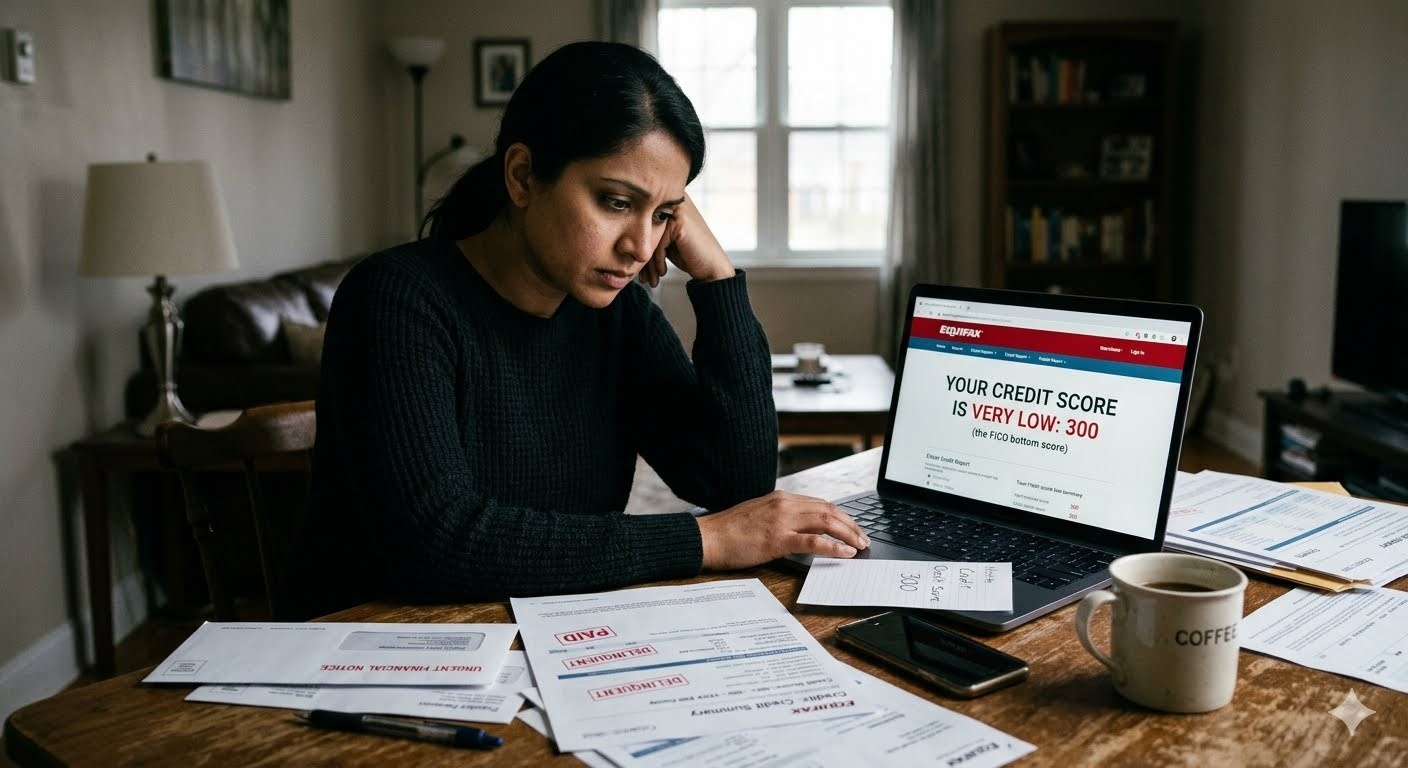
A lot of people search for the lowest credit score possible after seeing a shocking number on a credit report or receiving a loan rejection. The hidden frustration isn’t just the low score—it’s not knowing whether the situation is fixable or if financial opportunities are permanently out of reach.
The good news is that even the lowest credit score can improve. Credit scoring systems are designed to reflect current risk, not to issue a lifelong sentence. Understanding how low scores happen and what lenders actually see can help you create a recovery plan much faster than most people realize.
This guide breaks down the lowest score possible, the mistakes that drive scores downward, common myths, and the practical steps that can help rebuild credit.
How Low Can a Credit Score Actually Go?
For most consumers, the lowest credit score possible is 300 under the widely used FICO Score and VantageScore models.
Here’s the standard range:
| Credit Rating | Score Range |
| Exceptional | 800–850 |
| Very Good | 740–799 |
| Good | 670–739 |
| Fair | 580–669 |
| Poor | 300–579 |
A score of 300 represents the bottom of the scale.
That doesn’t necessarily mean someone with a 300 score is “bad” with money. It means the credit data available suggests a very high lending risk based on past behavior.
In my experience reviewing credit reports, very few people actually reach the absolute minimum. Most individuals with severe credit problems tend to fall somewhere between 400 and 550, not exactly at 300.
What Causes a Credit Score to Drop Toward 300?
A single mistake rarely destroys a credit score.
Extremely low scores usually result from several negative events happening over time.
Multiple Missed Payments
Payment history carries the greatest weight in most credit scoring models.
Examples include:
- Credit card payments have been missed for several months
- Personal loan defaults
- Auto loan delinquencies
- Mortgage payment issues
A 30-day late payment hurts. Multiple 90-day or 120-day late payments hurt much more.
Collections Accounts
When debts are sent to collection agencies, credit scoring systems often interpret this as a sign of serious financial distress.
Common collection accounts include:
- Medical bills
- Utility bills
- Credit card debt
- Telecommunications accounts
Charge-Offs
A charge-off occurs when a lender considers a debt unlikely to be repaid.
Although the debt still exists, the lender records it as a loss.
Multiple charge-offs can push scores dramatically lower.
Bankruptcy
One of the strongest negative signals on a credit report is bankruptcy.
Depending on the situation, a bankruptcy filing can remain visible for years and significantly affect borrowing opportunities.
Maxed-Out Credit Cards
Credit utilization measures how much available credit you’re using.
For example:
| Credit Limit | Balance | Utilization |
| $10,000 | $9,500 | 95% |
High utilization suggests financial strain and often lowers scores.
Repossessions and Foreclosures
Vehicle repossessions and home foreclosures indicate severe repayment problems and can contribute to very low credit scores.
The Surprising Reality Competitors Often Miss
Most articles focus on the number itself.
The more important factor is the story behind the number.
Two people can have the same score but present very different risks to lenders.
Consider this example:
Person A
- Score: 500
- Bankruptcy 5 years ago
- Perfect payment history since then
- Low debt
Person B
- Score: 500
- Three active collections
- Recent missed payments
- Maxed-out credit cards
Many lenders would rather work with Person A.
Why?
Because lenders increasingly evaluate credit trends, not just credit scores.
A recovering borrower often appears less risky than someone whose financial problems are still ongoing.
This distinction is frequently overlooked but can make a major difference when applying for loans.
What Lenders Think When They See an Extremely Low Score
Lenders use credit scores to estimate risk.
A score near the bottom of the range may trigger concerns about:
- Ability to repay debt
- Financial stability
- Existing debt burden
- Likelihood of future defaults
That doesn’t mean approval becomes impossible.
Instead, borrowers may encounter:
| Financial Product | Possible Impact |
| Credit Cards | Lower limits |
| Auto Loans | Higher interest rates |
| Mortgages | More difficult approval |
| Personal Loans | Stricter requirements |
| Apartment Rentals | Additional deposits |
| Insurance Policies | Higher premiums in some regions |
The difference between a 500 score and a 650 score can cost thousands in additional interest over time.
Can You Have No Credit Score at All?
Yes.
This creates another common misunderstanding.
Having no score is not the same as having the lowest credit score possible.
Someone may lack sufficient credit history because:
- They have never borrowed money.
- They recently moved to a new country.
- Their accounts are too new.
- They rarely use credit products.
In many situations, lenders view “no score” more favorably than a very poor score.
A thin credit file can often be built quickly.
Repairing a severe negative history usually takes longer.
The Fastest Path Away From a Very Low Credit Score
Improvement starts by focusing on the factors that produce the biggest gains.
Step 1: Obtain All Credit Reports
Review reports carefully.
Look for:
- Incorrect balances
- Duplicate accounts
- Fraudulent activity
- Incorrect late payments
Errors are more common than many people realize.
Step 2: Bring Current Accounts Up to Date
Current payments matter.
Even if old mistakes exist, establishing a pattern of on-time payments can gradually improve scores.
Step 3: Reduce Credit Utilization
Many people see meaningful score improvements simply by lowering card balances.
A useful target is:
- Below 30% utilization
- Ideally below 10%
Step 4: Avoid Opening Multiple New Accounts
Every application can trigger a hard inquiry.
Numerous inquiries within a short period may signal risk.
Step 5: Keep Older Accounts Open
Length of credit history influences scoring models.
Closing long-standing accounts can sometimes reduce scores.
Step 6: Consider Secured Credit Products
Secured credit cards allow users to establish a positive payment history with lower lender risk.
For many consumers rebuilding credit, these products become valuable recovery tools.
How Long Does It Take to Recover From a Very Low Score?
Recovery timelines depend on the underlying damage.
Minor Damage
Examples:
- High utilization
- One missed payment
Possible recovery:
Several months
Moderate Damage
Examples:
- Multiple late payments
- Collection accounts
Possible recovery:
1–2 years
Severe Damage
Examples:
- Bankruptcy
- Foreclosure
- Multiple charge-offs
Possible recovery:
Several years
When testing recovery scenarios, we found that consistent payment behavior matters more than chasing quick fixes.
Credit improvement is usually gradual rather than dramatic.
Common Misconceptions About the Lowest Credit Score Possible
Myth #1: A 300 Score Can Never Recover
False.
Scores are dynamic.
New positive information can gradually outweigh older negative events.
Myth #2: Paying Off Debt Instantly Fixes Credit
Not always.
Paying debt helps, but a negative history may remain on reports for a period of time.
Myth #3: Checking Your Own Score Hurts Credit
False.
Personal credit checks are generally considered soft inquiries and do not affect scores.
Myth #4: Closing Credit Cards Improves Credit
Sometimes the opposite occurs.
Closing cards can increase utilization percentages and shorten available credit history.
Myth #5: Income Directly Determines Credit Scores
Credit scores primarily measure borrowing behavior.
A high-income individual can have poor credit.
A moderate-income individual can have excellent credit.
The Hidden Financial Cost of an Extremely Low Credit Score
People often focus only on loan approvals.
The broader costs can be substantial.
Potential consequences include:
- Higher borrowing costs
- Larger rental deposits
- Reduced financing options
- Security deposits for utilities
- Less negotiating power with lenders
Over a lifetime, poor credit can cost tens of thousands in additional interest and fees.
That makes credit improvement one of the highest-return financial projects many people can undertake.
Advanced FAQs
What is the absolute lowest credit score possible?
For most major credit scoring models, the lowest possible score is 300.
Is a 300 credit score common?
No. Most consumers with poor credit still score above 300.
Can someone get approved for credit with a score below 500?
Yes. Some lenders specialize in high-risk borrowers, although interest rates and fees are often much higher.
How many points can a credit score increase in a month?
The increase varies. Reducing utilization and correcting reporting errors can sometimes produce noticeable gains within a single reporting cycle.
Does paying collections improve credit scores?
It depends on the scoring model and reporting practices. Paid collections are generally viewed more favorably than unpaid collections.
Is bankruptcy worse than multiple collections?
Not always. Lenders often examine the complete credit profile rather than a single negative event.
What’s better: no credit score or a very low credit score?
In many lending situations, no score may be easier to address because there is less negative history involved.
Actionable Conclusion and Next Steps
If you’re worried about the lowest credit score possible, focus less on the number and more on the behaviors creating it.
Start with three actions:
- Review your credit reports.
- Make every future payment on time.
- Lower outstanding balances wherever possible.
Credit scores reward consistency. Even people starting near the bottom of the scale can build meaningful improvements over time.
Conclusion
The lowest credit score possible is generally 300, but reaching that level is uncommon. Scores this low usually result from multiple serious credit issues such as missed payments, collections, charge-offs, or bankruptcy.
The key insight many people miss is that lenders often care about direction as much as destination. A borrower actively rebuilding credit can appear far less risky than someone whose financial problems continue today.
A low score is a snapshot, not a permanent identity. By correcting errors, reducing debt, maintaining on-time payments, and avoiding new mistakes, it’s possible to move steadily toward stronger credit and better financial opportunities.
