


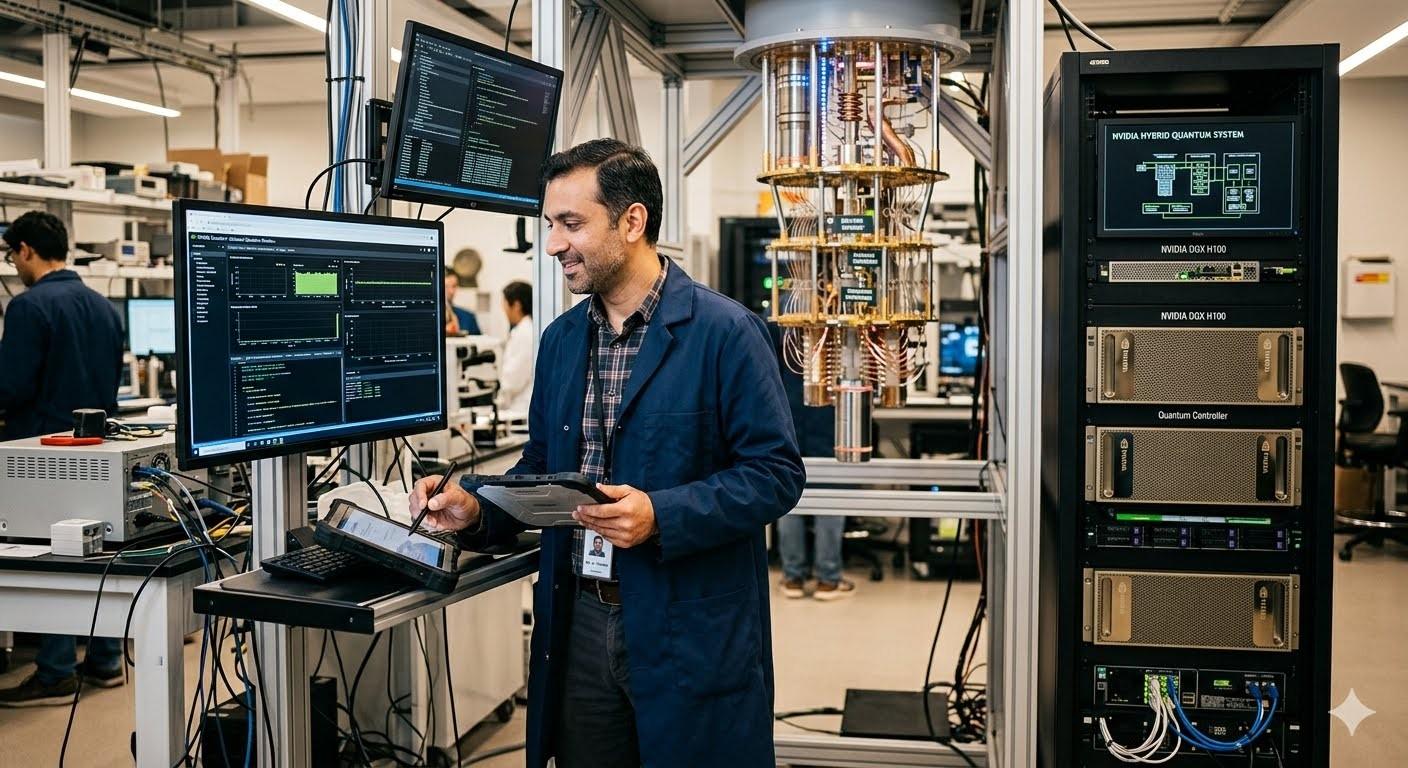
Most people searching for Nvidia quantum computing assume Nvidia is building a quantum computer.
It isn’t.
That misunderstanding has created a gap between public perception and what’s actually happening inside the quantum computing industry. While startups race to build more stable qubits and tech giants compete for quantum supremacy milestones, Nvidia has taken a different route.
Instead of manufacturing quantum processors, Nvidia is positioning itself as the company that may help connect quantum systems with classical computing infrastructure.
That distinction matters.
In my experience analyzing emerging computing technologies, the biggest breakthroughs rarely come from a single invention. They happen when different technologies become useful together. NVIDIA’s quantum strategy is built around that idea: hybrid computing, where GPUs and quantum processors work as one system.
Understanding this shift reveals where the industry is headed—and why Nvidia may play a larger role in quantum computing than many dedicated quantum hardware companies.
The Real Role of Nvidia in Quantum Computing
NVIDIA is best known for graphics processing units (GPUs), AI accelerators, and high-performance computing systems.
Quantum computing introduces a completely different architecture based on qubits rather than transistors. Since Nvidia doesn’t manufacture quantum processors, its role centers on three critical areas:
- Quantum simulation
- Quantum software development
- Hybrid quantum-classical computing
Think of quantum computers as specialized accelerators.
Just as GPUs accelerate AI workloads, quantum processors may eventually accelerate specific calculations involving optimization, chemistry, cryptography, and materials science.
The challenge is that quantum systems cannot operate independently at scale. They require classical computers for control, error correction, orchestration, and data processing.
This is where Nvidia enters the picture.
Why Quantum Computing Needs GPUs More Than Most People Realize
One fact often overlooked in discussions about quantum computing is that quantum computers spend a surprising amount of time interacting with classical systems.
Every quantum operation generates data.
Every qubit error requires analysis.
Every quantum experiment demands validation.
As quantum processors scale from hundreds to thousands—and eventually millions—of qubits, the amount of classical computing required increases dramatically.
The Hidden Bottleneck: Error Correction
Quantum systems are fragile.
Environmental noise, temperature fluctuations, and electromagnetic interference can introduce errors into calculations.
Researchers estimate that practical fault-tolerant quantum computing may require extensive error correction layers.
Those layers create enormous computational workloads.
GPUs are exceptionally good at handling:
- Parallel calculations
- Matrix operations
- Real-time data analysis
- AI-driven optimization
This makes them ideal companions for future quantum systems.
The industry’s long-term challenge isn’t simply creating more qubits.
It’s managing them efficiently.
NVIDIA CUDA-Q: The Company’s Most Important Quantum Project
If there’s one project that defines Nvidia’s quantum ambitions, it’s CUDA-Q.
CUDA transformed GPU programming by giving developers a standardized framework for building accelerated applications.
CUDA-Q attempts to do something similar for quantum computing.
What Is CUDA-Q?
CUDA-Q is an open-source platform designed for hybrid quantum-classical applications.
Developers can:
- Write quantum algorithms
- Simulate quantum processors
- Integrate GPU acceleration
- Run workloads across multiple computing environments
Instead of forcing researchers to choose between quantum and classical resources, CUDA-Q treats them as components of the same workflow.
This approach aligns with how many experts believe practical quantum computing will evolve.
Not as a replacement for classical computing.
As an extension of it.
The Hybrid Computing Model That Could Define the Next Decade
Many articles focus on quantum supremacy milestones.
A more useful question is:
How will organizations actually use quantum computers?
The answer is likely hybrid systems.
Traditional Model
| Component | Function |
| CPU | General processing |
| GPU | Parallel acceleration |
| Storage | Data management |
| Network | Communication |
Emerging Quantum Model
| Component | Function |
| CPU | Workflow orchestration |
| GPU | AI, simulation, error correction |
| Quantum Processor | Specialized quantum calculations |
| Storage | Massive dataset handling |
| Network | Distributed computing |
In this framework, quantum processors become another accelerator rather than a standalone replacement.
That perspective helps explain Nvidia’s strategic positioning.
The company already dominates accelerated computing.
Quantum computing becomes another layer within that ecosystem.
How Nvidia Simulates Quantum Computers Today
Building large-scale quantum hardware remains extremely difficult.
Simulation helps researchers experiment before physical systems mature.
NVIDIA GPUs can simulate quantum circuits at remarkable speeds compared to traditional CPU-only systems.
Researchers use simulation for:
- Algorithm testing
- Error modeling
- Hardware validation
- Educational purposes
- Quantum machine learning research
When testing new quantum workflows, simulation often reveals bottlenecks long before expensive hardware deployment.
This makes simulation one of the most valuable parts of the quantum development cycle.
And simulation is where Nvidia already has significant expertise.
The AI Connection Most Competitors Ignore
Here’s the angle many discussions miss.
The future relationship between AI and quantum computing may be more important than quantum computing alone.
NVIDIA sits at the center of the AI revolution.
That creates unique opportunities.
Quantum Computing Generates Complexity
Quantum systems produce:
- Large datasets
- Error signals
- Hardware telemetry
- Experimental outputs
AI Helps Manage Complexity
Machine learning models can:
- Detect quantum errors
- Optimize circuits
- Predict hardware performance
- Improve calibration
As quantum systems become larger, AI-driven management may become essential.
This creates a feedback loop:
- GPUs accelerate AI.
- AI improves quantum systems.
- Quantum processors solve specialized tasks.
- GPUs manage the entire ecosystem.
The companies capable of integrating all three layers may gain the greatest advantage.
NVIDIA’s Partnerships Across the Quantum Industry
Another overlooked aspect of Nvidia’s quantum computing is its partnership strategy.
Rather than competing directly with quantum hardware companies, Nvidia collaborates with many of them.
Examples include organizations working with:
- Superconducting qubits
- Trapped-ion systems
- Neutral-atom architectures
- Photonic quantum computers
This hardware-neutral approach reduces risk.
No one knows which quantum architecture will dominate.
By supporting multiple platforms, Nvidia benefits regardless of which technology wins.
It’s a strategy similar to how the company supports numerous AI frameworks rather than relying on a single model ecosystem.
Common Misconceptions About Nvidia Quantum Computing
Misconception #1: Nvidia Is Building Its Own Quantum Computer
At present, Nvidia’s focus is on software, simulation, acceleration, and hybrid infrastructure—not on manufacturing quantum processors.
Misconception #2: Quantum Computers Will Replace GPUs
Quantum processors excel at specific problems.
GPUs remain superior for AI training, graphics, simulations, and many parallel workloads.
The technologies are complementary.
Misconception #3: Quantum Computing Will Arrive Overnight
Progress is happening, but practical large-scale deployment remains a long-term engineering challenge.
Organizations should prepare for gradual integration rather than sudden disruption.
Misconception #4: Quantum Computing Only Matters for Scientists
Potential applications extend into:
- Financial modeling
- Logistics optimization
- Drug discovery
- Materials science
- Energy systems
- Cybersecurity
Many industries could eventually benefit.
Misconception #5: More Qubits Automatically Mean Better Performance
Qubit quality often matters more than quantity.
Error rates, coherence times, and connectivity significantly affect real-world capability.
Industries Most Likely to Benefit First
Not every sector will adopt quantum computing simultaneously.
Early adoption will likely occur where computational complexity creates massive economic value.
Pharmaceutical Research
Drug discovery requires analyzing molecular interactions at extraordinary scales.
Quantum systems could improve simulation accuracy.
Financial Services
Portfolio optimization and risk analysis involve large combinatorial problems.
Hybrid computing may offer advantages here.
Materials Science
Researchers can explore new battery materials, superconductors, and industrial compounds.
Logistics and Supply Chains
Optimization challenges grow exponentially as networks become more complex.
Energy
Grid optimization and advanced energy modeling may benefit from quantum acceleration.
In many of these cases, Nvidia-powered hybrid infrastructure could serve as the bridge between classical and quantum resources.
What Investors, Developers, and Businesses Should Watch
The biggest indicator of progress isn’t a record-breaking qubit count.
Watch for:
- Improved quantum error correction
- Larger hybrid deployments
- Growth of CUDA-Q adoption
- AI-assisted quantum workflows
- Quantum cloud infrastructure expansion
These developments reveal whether quantum computing is becoming commercially useful.
Hardware milestones generate headlines.
Software ecosystems create lasting value.
History repeatedly shows that platforms often become more influential than individual devices.
Advanced FAQs
Is Nvidia a quantum computing company?
Not in the traditional sense. NVIDIA does not build quantum processors. It develops software, simulation platforms, and hybrid computing infrastructure that support quantum computing.
What is CUDA-Q?
CUDA-Q is Nvidia’s open-source platform for developing and running hybrid quantum-classical applications across different quantum hardware environments.
Can Nvidia GPUs simulate quantum computers?
Yes. GPUs are widely used for quantum circuit simulation, algorithm testing, and quantum research workloads.
Will AI and quantum computing merge?
Many experts believe future quantum systems will rely heavily on AI for optimization, calibration, and error management, making AI and quantum computing increasingly interconnected.
Does Nvidia benefit if another company builds the best quantum computer?
Potentially yes. NVIDIA’s strategy centers on enabling hybrid systems, meaning its software and GPU infrastructure could support multiple quantum hardware providers.
When will quantum computing become mainstream?
Most experts expect gradual adoption over the coming decade rather than immediate widespread deployment. Progress depends heavily on advances in scalability and error correction.
Actionable Conclusion and Next Steps
If you’re evaluating Nvidia quantum computing, stop asking whether Nvidia will build a quantum computer.
The more important question is whether Nvidia will become the infrastructure layer connecting AI, classical computing, and quantum systems.
Current evidence suggests that the possibility is very real.
For developers, learning CUDA-Q and hybrid computing concepts may provide an early advantage.
For businesses, identifying optimization and simulation challenges today can prepare organizations for future quantum integration.
For investors, ecosystem growth may prove more important than headline-grabbing qubit announcements.
The companies enabling quantum computing at scale could become just as valuable as those building the quantum hardware itself.
Conclusion
NVIDIA’s quantum strategy stands apart from the industry’s hardware race. Rather than pursuing qubit leadership, the company is building the software, simulation tools, GPU acceleration, and hybrid infrastructure needed to make quantum computing useful in real-world environments.
The most overlooked insight is that the future likely belongs to hybrid computing systems, where CPUs, GPUs, AI models, and quantum processors operate together. If that vision becomes reality, Nvidia’s position in the quantum ecosystem could be far more significant than many people currently recognize.
